Ryutta Handwritten Font for Crafters & Sellers
As a handmade seller who’s spent years testing fonts on everything from candle labels to wedding welcome boards, I’ll tell you straight: Ryutta isn’t just another pretty script font. It’s the kind of handwritten typeface that feels personal without sacrificing polish—soft enough for romance, structured enough for clarity, and versatile enough to earn its place in my core design toolkit.
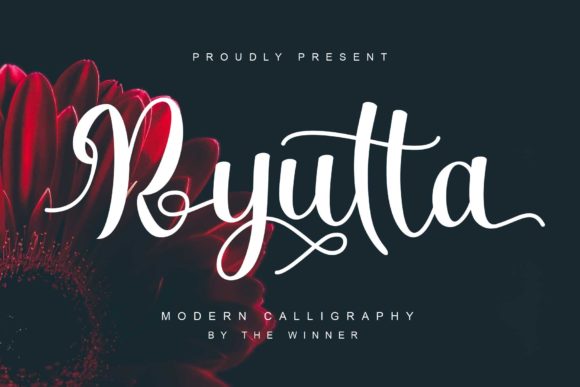
Ryutta is an enchanting handwritten font with gentle curves, natural stroke variation, and subtle bounce—like inked by hand but refined for real-world use. It’s not overly ornate or fussy; instead, it balances warmth and legibility in a way that makes customers pause, smile, and remember your brand. Whether you’re designing printable planner pages for Etsy, cutting vinyl decals for boutique gift tags, or laying out elegant invitation suites, Ryutta delivers consistent charm across formats and scales.
Where Ryutta Shines in Physical & Digital Craft Projects
I reach for Ryutta most often when I need emotional resonance paired with commercial practicality. Here’s where it consistently delivers:
- Greeting cards & invitations: Its romantic flow works beautifully for “Happy Birthday,” “You’re Invited,” or “Thank You” on folded cards—especially when printed on textured cotton paper or foil-stamped stock.
- Product labels & packaging: I’ve used Ryutta for small-batch soap labels, jam jar tags, and herbal tea sachets. At 14–16pt, it remains highly readable on matte kraft stickers—even under low-light retail settings.
- Wall art & signs: As a display font, Ryutta adds farmhouse elegance to wooden signs (“Gather,” “Home,” “Brew”) and modern charm to acrylic wall prints. Its spacing holds up well at 3–6 inches tall, and it cuts cleanly on Cricut and Silhouette machines when converted to outlines.
- Digital printables & templates: Planner covers, habit trackers, and printable quote art all benefit from Ryutta’s expressive rhythm. Paired with a clean sans serif for body text, it creates hierarchy without visual fatigue.
- Apparel & merchandise: On tote bags, mugs, and tees, Ryutta reads clearly at medium sizes (e.g., “Made With Love” across a chest pocket). Avoid ultra-thin strokes at very small sizes—stick to 20pt+ for embroidery or sublimation transfers.
Readability Tips That Save Time & Materials
Not all script fonts behave the same on cutting machines or printed surfaces—and Ryutta handles itself thoughtfully. For best results:
- Use the regular weight only for small stickers (under 1.5") and delicate product tags—it avoids thin hairlines that may break during vinyl weeding or laser printing.
- When scaling above 48pt for signage or SVG wall art, enable OpenType features like swashes and contextual alternates (if included) to add graceful variation without manual tweaking.
- Always convert to outlines before sending to print vendors or cutting software—this prevents font substitution and ensures your spacing stays intact.
- Test print a single word at your target size on your actual paper or label stock first. Ryutta’s baseline consistency means it rarely needs kerning adjustments—but your substrate might.
Smart Pairings That Elevate Your Brand Identity
Ryutta thrives in contrast. As a premium script font, it gains strength—and professionalism—when paired with something grounded. My go-to combinations:
- Ryutta + Montserrat or Inter: Clean, neutral sans serifs balance Ryutta’s expressiveness—ideal for business cards, shop banners, and digital product mockups.
- Ryutta + Lora or Playfair Display: A refined serif adds typographic depth for luxury stationery lines, bridal collections, or boutique packaging where tradition meets modern sensibility.
- Avoid pairing Ryutta with other scripts or decorative fonts unless intentionally layered (e.g., Ryutta for a name, a bold geometric sans for a tagline). Too much movement competes for attention.
Licensing, Formats & Real-World Fit
Ryutta is part of the Script Amp collection—a curated set of commercially viable handwritten fonts built for makers. When you license Ryutta, you’re getting more than just .OTF files. Most versions include web-ready WOFF/WOFF2, full multilingual support (including extended Latin characters), and OpenType features like discretionary ligatures and stylistic sets—handy for refining “Th,” “To,” or “The” in headlines.
Importantly, Ryutta’s commercial license covers physical products you sell (candles, apparel, prints), digital downloads (printables, Canva templates, SVG bundles), and client work—including logos and packaging design. Just double-check your license terms before bundling into subscription-based design assets or reselling the font itself.
What sets Ryutta apart isn’t just aesthetics—it’s how reliably it performs across mediums. It doesn’t look pixelated on social media graphics, doesn’t choke on fine-cut vinyl, and doesn’t lose personality when scaled down for a tiny sticker. That kind of consistency builds trust—not just with your customers, but with your own workflow.
If you’re curating a font library that supports both heart-led creativity and repeatable production, Ryutta earns its spot as a foundational script font—not as decoration, but as a working tool. It’s the kind of typeface that quietly elevates your brand identity while making your next batch of holiday gift tags, wedding suite proofs, or seasonal shop banners feel effortlessly intentional.